(IN) BETWEEN HOUSE by Type 0 Architects
Framed by ornate colonial-era facades on one side and the commercial energy of Orchard Road on the other, the residence occupies a rare threshold between old and new, quiet and animated, domestic and urban.
The project is by Singapore-based Type 0 Architects, a practice known for its deep inquiry into building typologies and their capacity for transformation. Rather than treating historical forms as static artifacts, Type 0 approaches architecture as an evolving system shaped by climate, culture, structure, and daily life. Their work focuses on understanding the inner logic of building types—how they handle light, air, circulation, and social interaction—and then reframing these qualities through precise sectional strategies and restrained material choices. In (IN) BETWEEN HOUSE, this philosophy is expressed through a careful recalibration of the shophouse typology, turning a once-fragmented interior into a connected and generous family home.
Originally, the conserved property was organised around split levels and a central staircase positioned at the first airwell. While the owners appreciated the character of these varied floor plates, the arrangement created visual and functional separation, dividing the length of the house into three vertical stacks and blocking light from penetrating deep into the plan. Typical of many shophouses, the interior felt dark and compartmentalised, with circulation interrupting both airflow and family life.
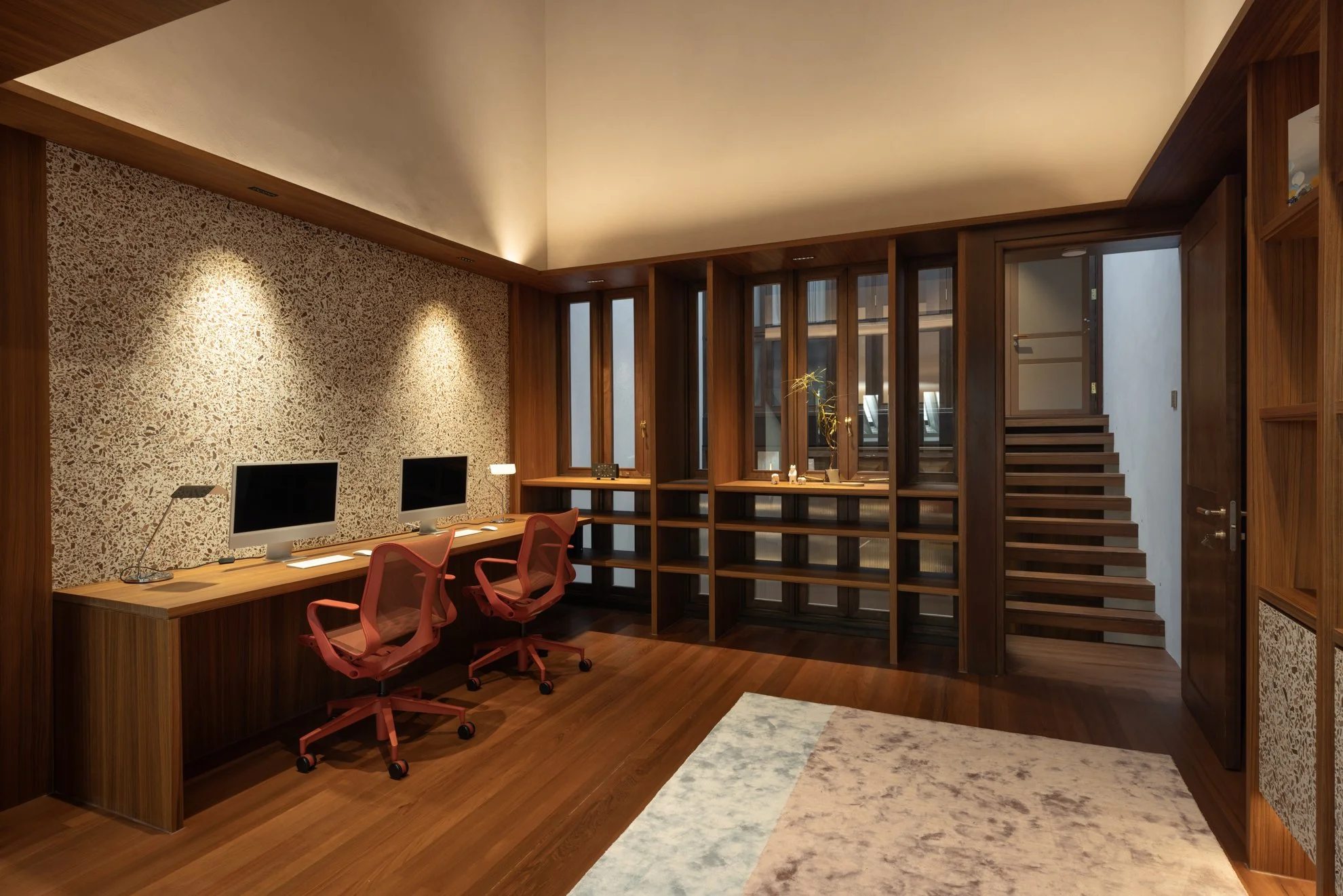
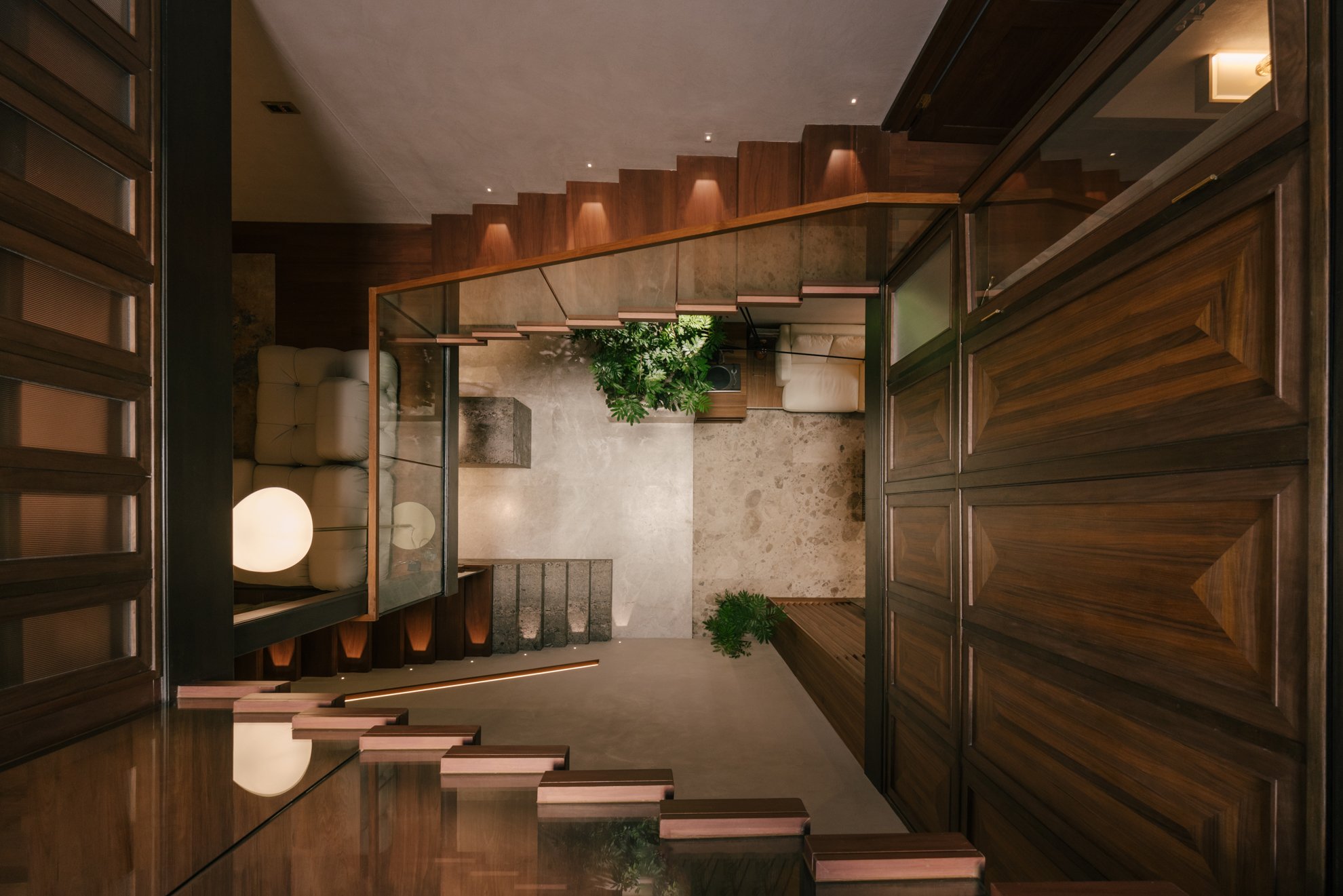
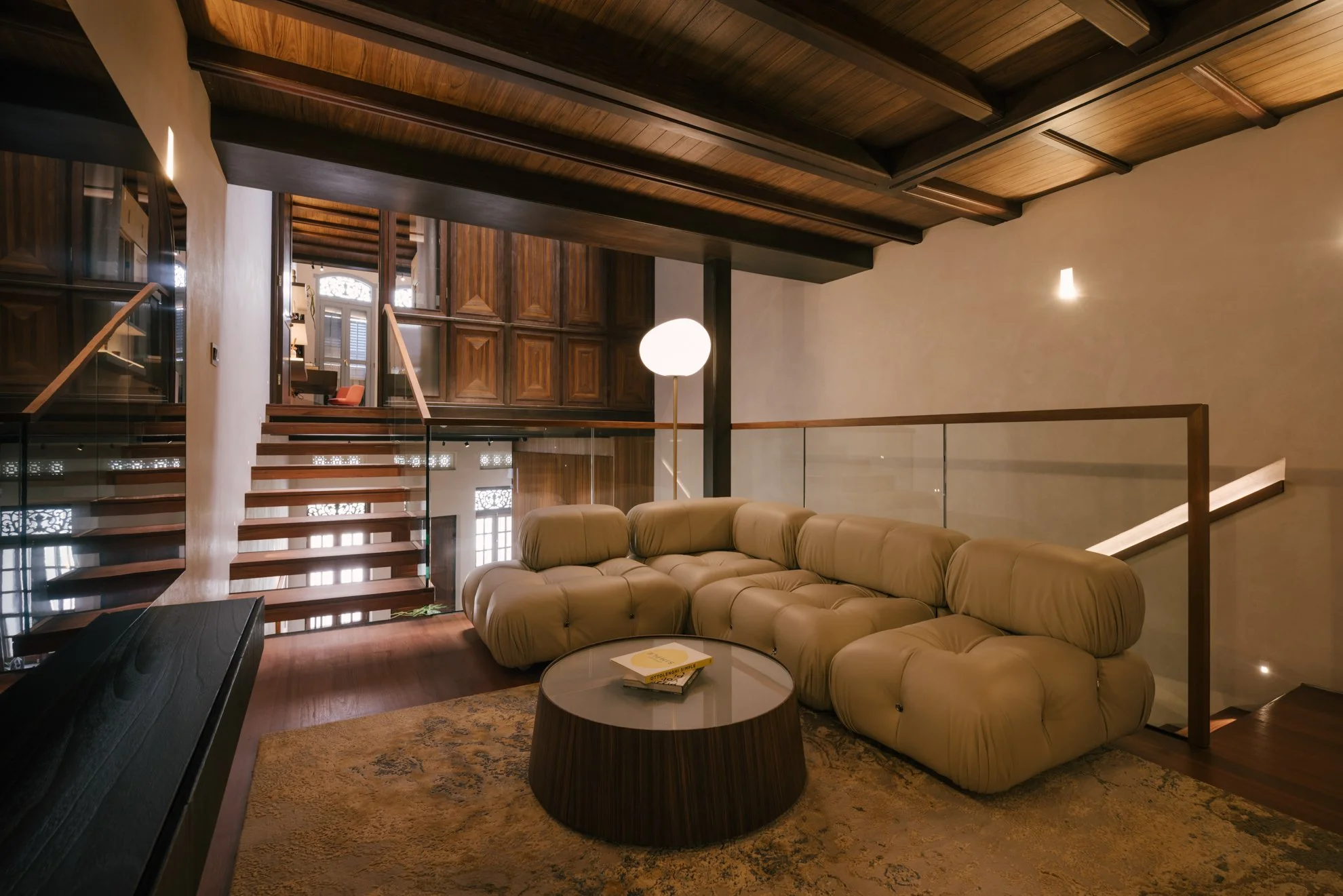
Working within URA conservation guidelines—which required the existing floor levels to be retained—Type 0 Architects proposed a bold typological shift. The conventional dog-legged staircase was removed and replaced with a continuous system of floating platforms aligned along the party walls. These enlarged landings form a series of communal mezzanines, transforming circulation into a shared experience. A family platform branches toward the master bedroom, while a study-playroom connects the children’s rooms, allowing daily routines to intersect naturally.
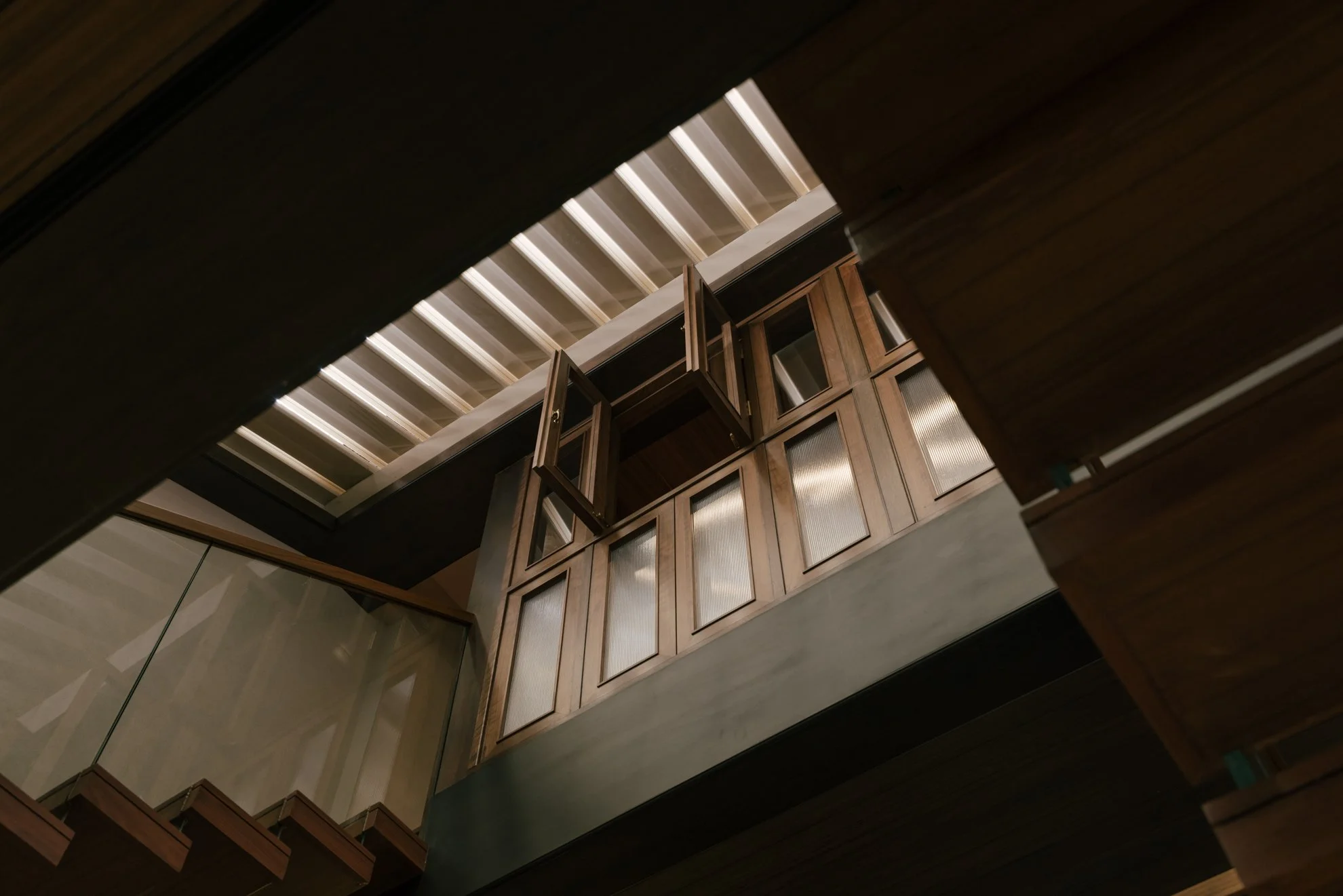
This reorganisation freed up the centre of the house, creating a new vertical void beneath the front jack roof, effectively adding a second air and lightwell to complement the existing rear one. Because conservation rules limit natural skylight openings at the front roof, a discreet artificial skylight was introduced to project daylight down to the ground floor. Together, the two lightwells improve stack ventilation and illumination throughout the home, bringing air and daylight to gathering platforms and private rooms alike, and addressing the stuffiness typical of this building type.
At ground level, the removal of the central stair enabled a rare open-plan layout that allows uninterrupted views from front to back—a highly unusual condition in shophouses. This visual continuity amplifies the perceived depth of the narrow site and replaces the former sense of confinement with openness and discovery.
The owners—a family of four—were closely involved in shaping the brief. The husband, a businessman who travels frequently, is also a collector of traditional ink wash paintings, while his wife owns several restaurants and enjoys cooking and baking with friends and family at home. With two young children and frequent gatherings, the couple requested generous communal areas alongside private bedrooms, a study, helper’s quarters in the basement, and multiple living zones, including a family lounge overlooking the social areas.
Tucked into the historic Peranakan enclave of Emerald Hill, (IN) BETWEEN HOUSE reimagines a conserved Chinese Baroque shophouse as a contemporary family home, carefully balancing heritage preservation with the realities of modern living.



Their mixed cultural background drew them to Emerald Hill’s Peranakan heritage, appreciating both the neighbourhood’s historic character and its proximity to Singapore’s modern retail core. This duality informed much of the interior approach.
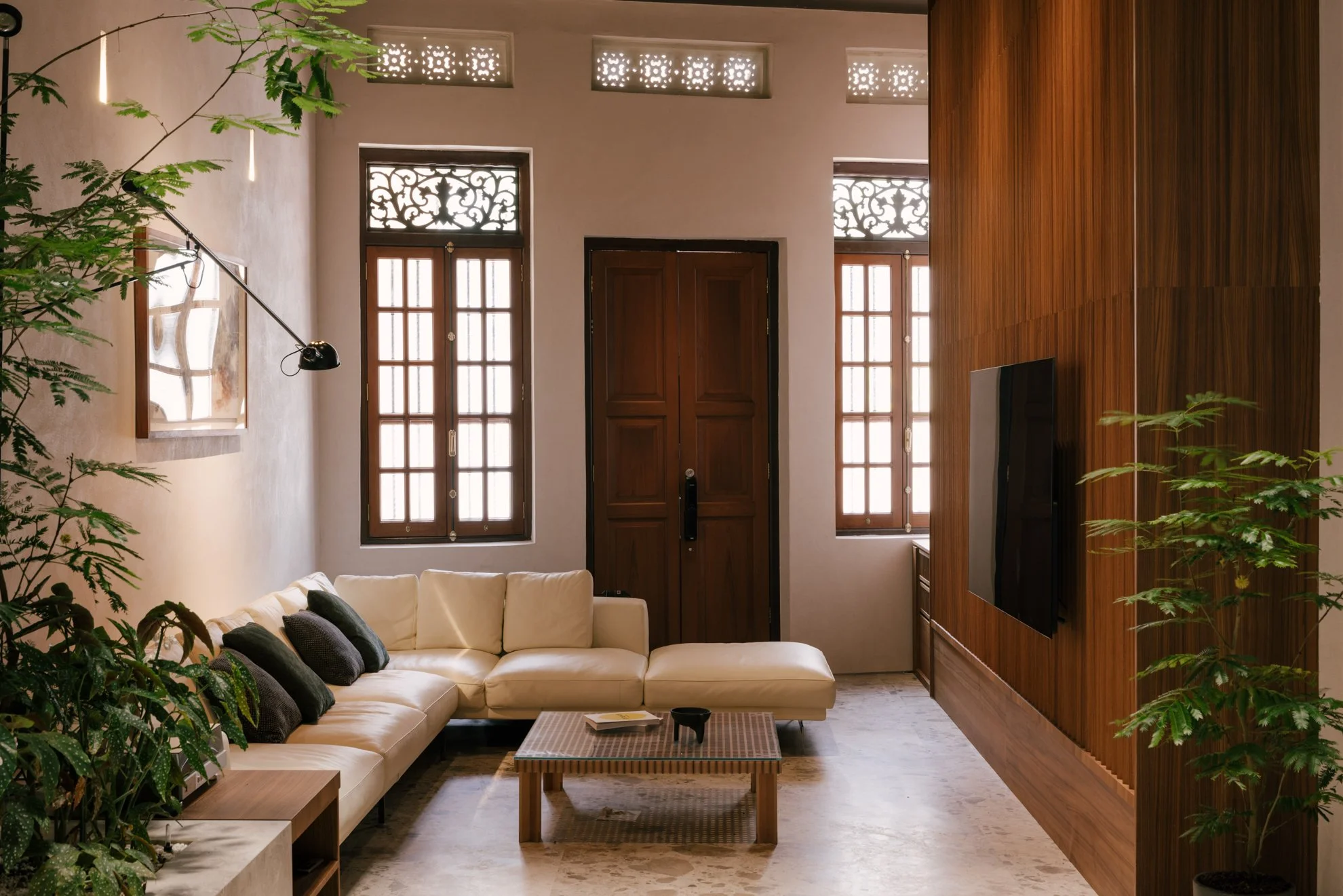
One of the project’s defining gestures is the reinterpretation of the living room as a contemporary “forecourt.” Positioned between the first airwell and the dining area, it acts as a threshold within the home, framed by teak finishes and lush planting. Underfoot, beige Ceppo stone—typically associated with outdoor landscapes—sets a tactile foundation for the living area. This material continues inward as Pietra Da Torre on the dry kitchen islands, while the dining room sits slightly elevated on Perlado Grigio, subtly signalling a shift from public to semi-private domains.
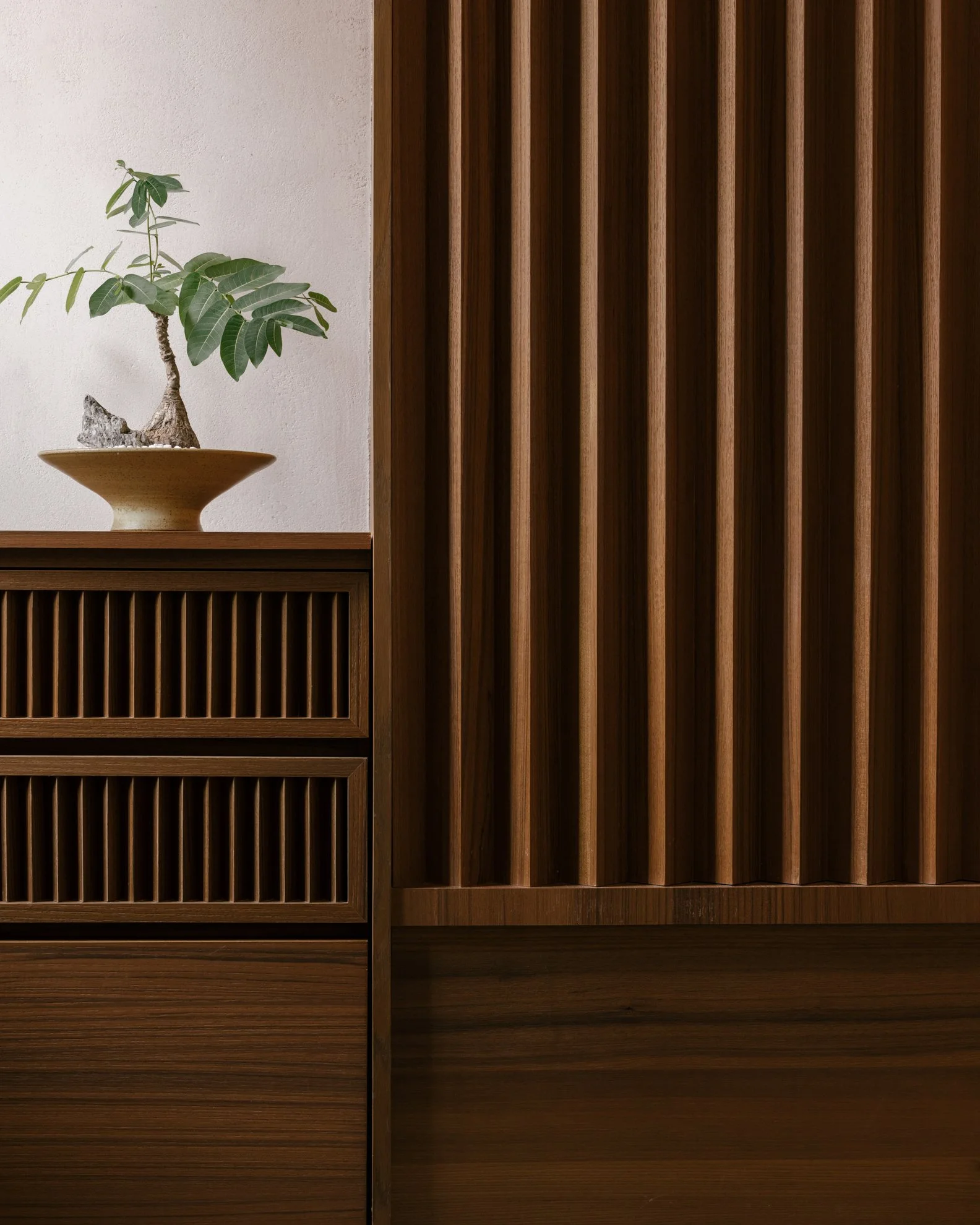
Throughout the house, natural materials form the backbone of the palette. The owners were immediately drawn to the original timber interiors, particularly the warmth of tropical hardwoods. This appreciation guided the material strategy: architectural elements such as floors, beams, joists, staircases, and internal facades are expressed in teak and Chenghai, complementing existing heritage features like floor joists and granite corbels.
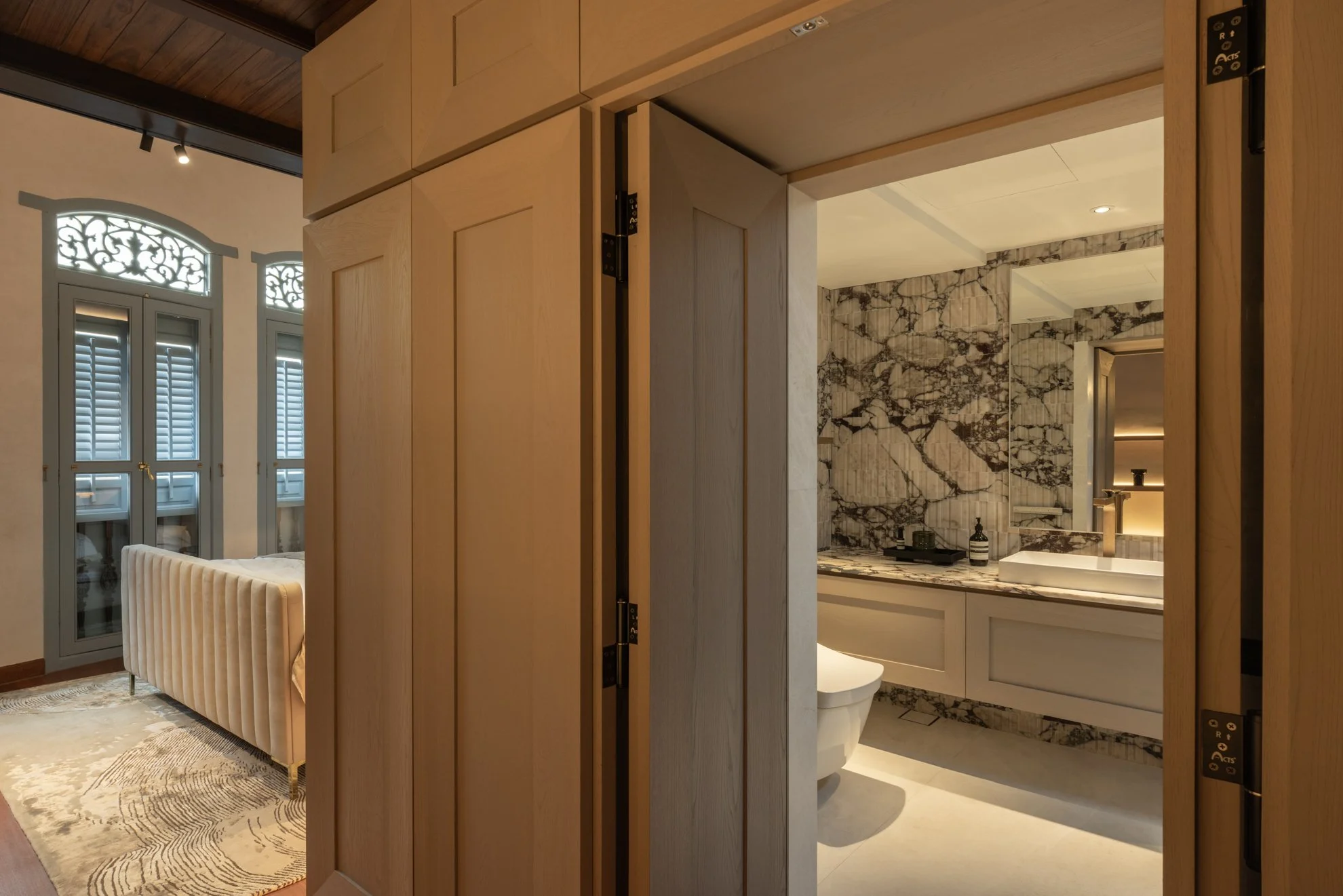
Introduced carpentry varies by room, from natural oak in the children’s bedrooms to dyed veneers in the master suite, creating layered visual interest while maintaining a cohesive timber language. Stone transitions from the more rustic Ceppo at ground level to refined marbles in the bathrooms, including Breccia Viola, Honed White Pearl, and Breccia Capraia, offering moments of quiet luxury for daily rituals. In the study-playroom, Foresso—an eco-friendly timber terrazzo—brings together stone and wood in a playful, tactile surface suited to family life.
To further blur the line between inside and outside, the internal facades facing the airwells were custom-crafted to mirror the external timber casement windows, extending Peranakan fenestration motifs into the interior. In the master bedroom, teak veneered marquetry panels fronting the first airwell signal the head of the household, referencing traditional Peranakan ornamentation in a contemporary way.
Art also plays a significant role. The owner’s collection of ink wash paintings by three prominent Singaporean artists is thoughtfully placed throughout the house, paying tribute to the shophouse as a uniquely local building type while adding quiet moments of contemplation within the home.
Across its split levels, the residence reads as a three-storey dwelling, accommodating three main bedrooms, a study, helper’s quarters, living and dining rooms, wet and dry kitchens, and a family lounge. Yet it is the continuity between these areas—rather than their separation—that defines the experience of the house.